

CTE Isn't Plan B
TL;DR: Career and technical education is not a fallback for students who won't go to college. Two decades of research show that students who complete a CTE program graduate high school at higher rates, are more likely to be employed after graduation, and are no less likely to enroll in a four-year college than their peers. The benefits come from real programs (a multi-year sequence, industry credentials, work-based learning), not a one-off elective. With the trades short-handed, college costs rising, and employers hiring for skills, that pathway matters more now than it did a generation ago.
The Wrong Question
Sooner or later, most parents of a teenager ask some version of the same thing: should my kid aim for college, or learn a trade? Twenty years of research gives an answer most people don't expect. Students who complete a career and technical education (CTE) program in high school are more likely to graduate, more likely to be employed, and no less likely to enroll in a four-year college than their peers.
College or trade is a false choice. The real question is whether a student's four years of high school connect to anything beyond the next test.
What the Research Actually Shows
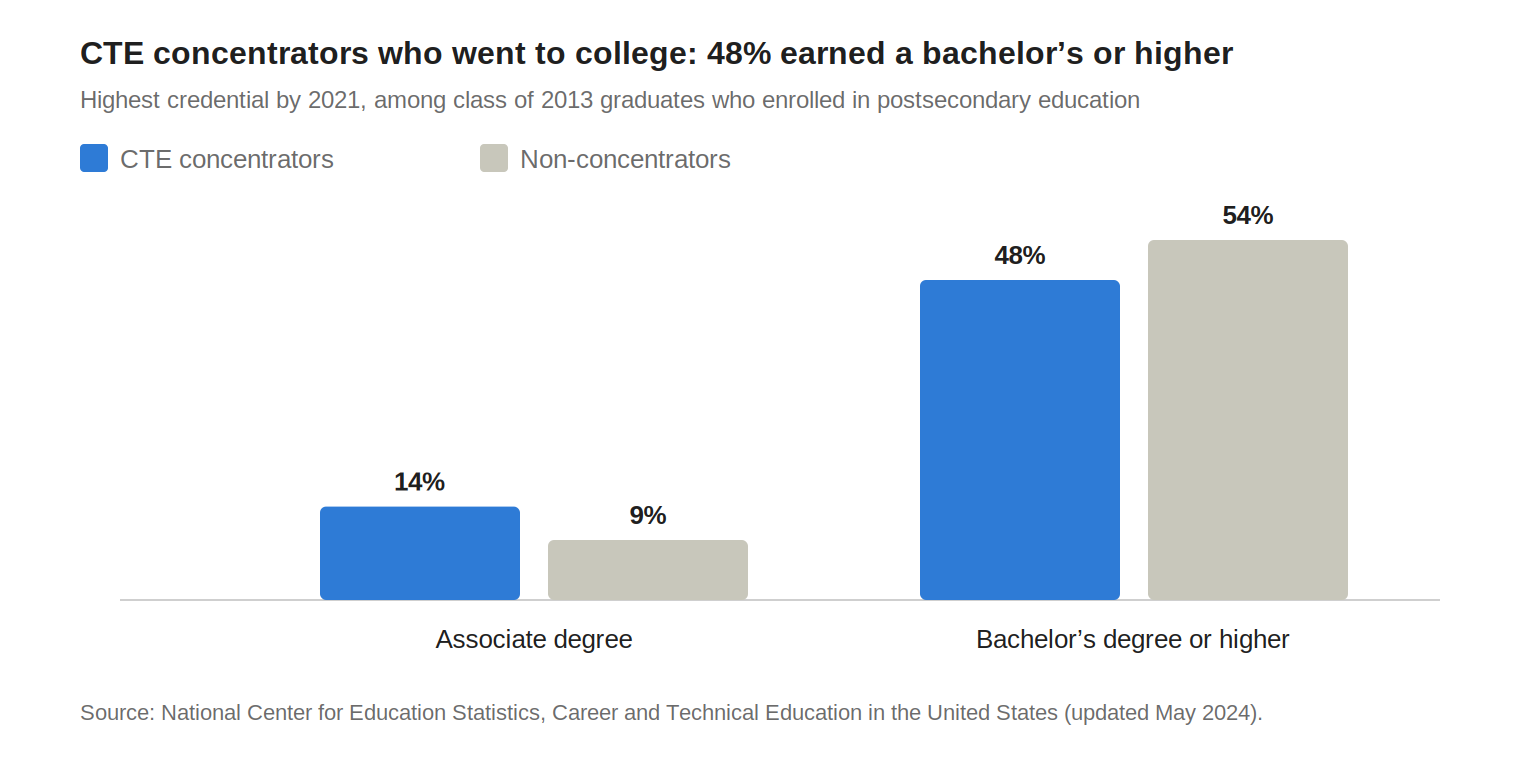
The strongest evidence comes from a 2024 systematic review by the federally funded CTE Research Network, which analyzed roughly two decades of studies. Across that body of work, high school CTE participation had statistically significant positive effects on high school completion, academic achievement, college readiness, and employment after graduation. CTE students were more likely to enroll in two-year colleges and no less likely to enroll in four-year colleges. Federal data point the same way: among CTE concentrators from the class of 2013 who went on to college, 48% had earned a bachelor's degree or higher by 2021, compared with 54% of their non-CTE peers, and more of them had earned an associate degree.
Here are some more research studies:
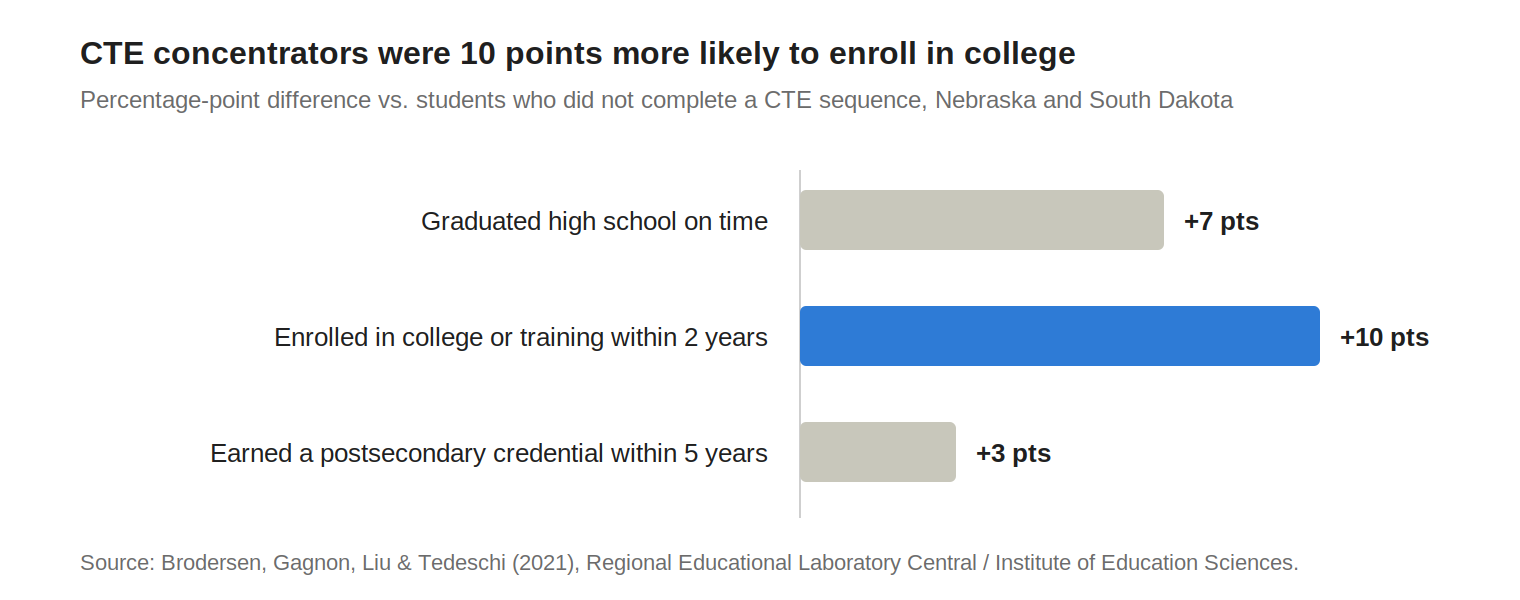
Graduation and college enrollment. A 2021 U.S. Department of Education study of Nebraska and South Dakota found that CTE concentrators (students who completed a sequence of courses in one career field) were 7 percentage points more likely to graduate on time, 10 points more likely to enroll in postsecondary education within two years, and 3 points more likely to earn a postsecondary credential within five years.
Earnings. A 2023 study in The Review of Economics and Statistics followed students who attended Connecticut's standalone technical high schools. Male students who attended were 10 percentage points more likely to graduate and earned about 32% more per quarter in the years after high school, an effect that held well past the usual college-going years. The study found no measurable effect for female students, a reminder that results vary by program and population.
Access. When Massachusetts expanded access to state-approved CTE programs, newly enrolled students worked more quarters, and those who were employed earned about 9% more one year after graduation, according to Harvard Kennedy School researchers, with suggestive evidence that some programs also raised four-year college enrollment.
None of this says every CTE student out-earns every college graduate. It says a well-built program raises the floor on graduation and employment without lowering the ceiling on college.
Why This Matters More Now Than a Generation Ago
Three things have changed since today's parents were in high school.
The trades are short-handed, and Arizona especially so. The skilled workforce that built the last forty years is retiring faster than it is being replaced, in electrical, plumbing, HVAC, welding, and construction. In Arizona, semiconductor fabs, data centers, and a decade of housing and infrastructure growth have pushed demand for technicians past what the pipeline supplies. A graduate with an industry credential and two years of hands-on training is entering a seller's market.
College got expensive, and finishing it got harder. A bachelor's degree still pays off on average, but the average hides a lot. By most national estimates, close to four in ten students who start college have not finished six years later, and those who leave with debt and no degree fare worst of all. CTE does not argue against college. It makes sure a student who goes has a reason, and a student who doesn't has a plan.
Employers are hiring for skills. A growing list of major employers and state governments have dropped degree requirements for many roles in favor of demonstrated competence and industry credentials. And as AI reshapes entry-level office work, the jobs that are hardest to automate are the ones done with your hands, on site, under a license.
What a Good Program Looks Like
Not all CTE is equal, and the research is clear about where the benefits come from. Nearly 85% of high school graduates earn at least one CTE credit. Far fewer complete a coherent sequence, and the sequence is where the outcomes live. When comparing programs, parents should look for four things:
A sequence, not a sampler. Two or more years of connected courses in one field, building toward a capstone or a credential. One semester of shop class is exposure; a program is a path.
Industry credentials earned before graduation. Certifications employers actually recognize, the kind the Arizona Department of Education tracks by program, give an 18-year-old something to put on an application that a transcript cannot.
Work-based learning. Internships, job shadows, and employer partnerships. The strongest programs put students in front of real work and real employers before they leave high school.
Career training that is part of the school's design. The Connecticut results came from schools built around technical education, not from an elective added to a regular schedule. Students should leave with a diploma that opens college and a skill set that opens a job, earned in the same four years.
An On-Ramp, Not an Off-Ramp
The old picture of vocational education, a track for students who weren't "college material," was wrong then and is wrong now. The evidence points the other way: students who learn a trade in high school finish high school more often, go on to college at the same or higher rates, and start earning sooner.
ALA Applied Technologies High School was built on that premise: a full high school diploma and hands-on career training in the same school day, with industry credentials students can earn before they graduate. [Insert one sentence naming two or three flagship programs.] If your student learns best by building, fixing, designing, or doing, [schedule a tour / explore our programs / enroll today].
Sources
Lindsay, Jim, Katherine Hughes, Shaun M. Dougherty, Kelly Reese and Megha Joshi. “What We Know About the Impact of Career and Technical Education: A Systematic Review of the Research.” CTE Research Network, 2024.
Brodersen, Marc, Douglas Gagnon, Jing Liu and Steven Tedeschi. “The Impact of Career and Technical Education on Postsecondary Outcomes in Nebraska and South Dakota.” Regional Educational Laboratory Central, Institute of Education Sciences, 2021.
Brunner, Eric J., Shaun M. Dougherty and Stephen L. Ross. “The Effects of Career and Technical Education: Evidence From the Connecticut Technical High School System.” The Review of Economics and Statistics, 2023.
Harvard Kennedy School. “Does Expanding Access to High Quality Technical Education Induce Participation and Improve Outcomes?”
National Center for Education Statistics. “Career and Technical Education in the United States.” U.S. Department of Education, updated May 2024.
Arizona Department of Education. “CTE Data and Accountability.”